May 19, 2026
Virtual reality in the hospital: What immersive therapy is and how it works
Virtual reality in the hospital: What immersive therapy is and how it works
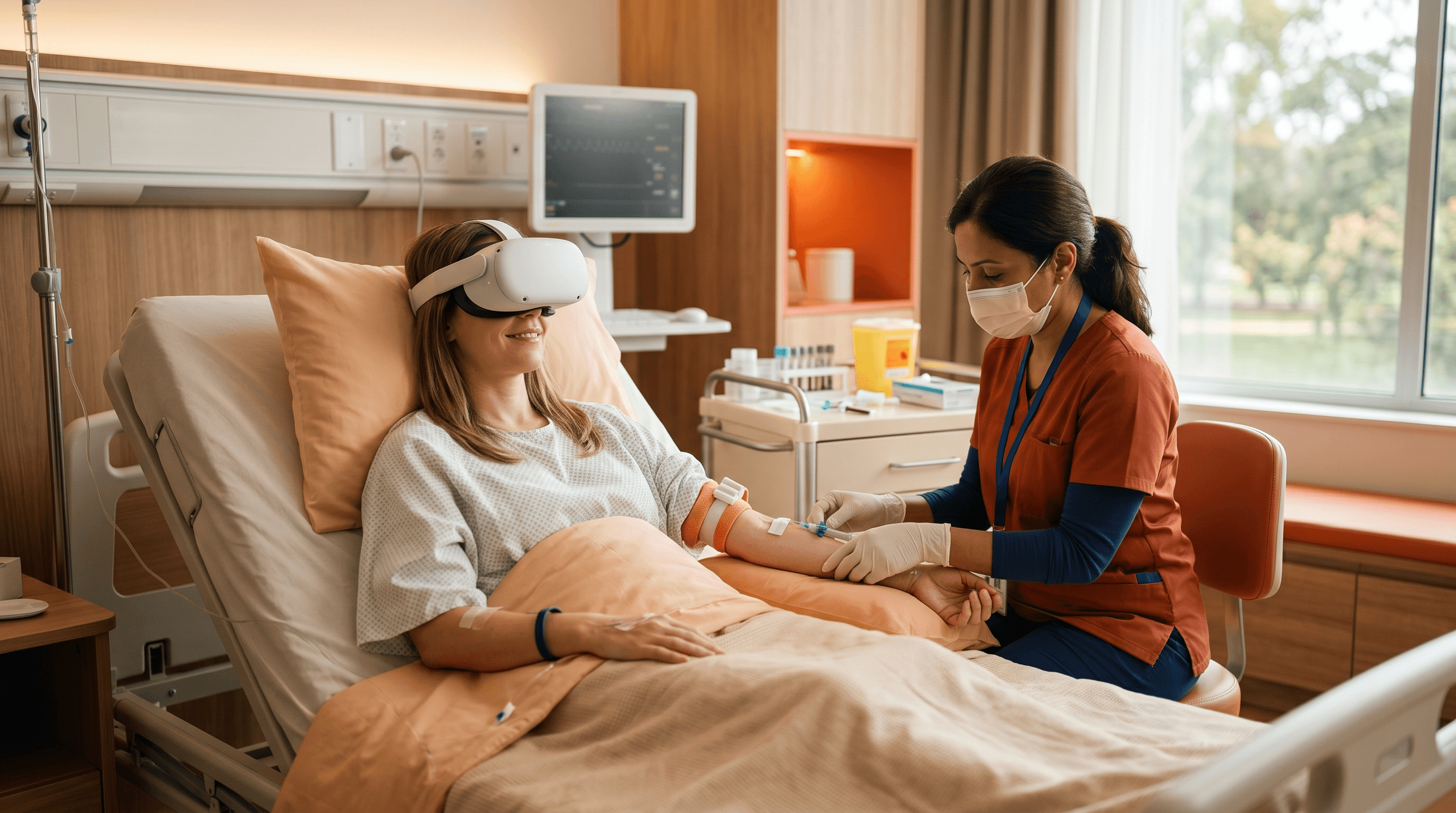
What is Immersive Therapy
Immersive therapy is the clinical use of virtual reality to reduce pain, anxiety, and stress during medical procedures. The patient wears a VR headset and is transported into an engaging three-dimensional environment while healthcare staff perform the procedure.
It is not entertainment. It is a clinically validated therapeutic intervention that leverages a precise neurological principle: the brain has limited attentional resources. If attention is captured by an immersive experience, pain and anxiety signals are processed with less intensity.
How it works at a neurological level
The mechanism is called multimodal cognitive distraction. For an in-depth explanation, read Why Virtual Reality Reduces Pain: The Science Explained Simply. Here is what happens in the brain during an immersive therapy session:
1. Attention saturation
The VR headset simultaneously engages sight, hearing, and proprioception. The brain has a limited attentional capacity: if it is busy processing an immersive environment, it has fewer resources available to process pain.
2. Reduced activation of the amygdala
Neuroimaging studies show that during the use of immersive VR, the amygdala reduces its activity. The patient perceives less of a threat.
3. Gate control modulation
The gate control theory (Melzack & Wall, 1965) explains that non-painful stimuli can "close the gate" to pain transmission in the spinal cord. The sensory input from VR acts as a modulator.
4. Activation of the reward system
Pleasant environments and playful interactions activate the release of dopamine and endorphins, creating a natural analgesic effect.
Scientific evidence
The scientific literature on VR in the clinical field is robust and growing exponentially.
Procedural pain:
A meta-analysis of 20 randomized controlled trials demonstrated an average reduction in pain of 44% during needle procedures (Czech et al., 2022). This figure is comparable to the effect of an oral analgesic.
Colonoscopy:
A 2025 randomized study showed that immersive VR during colonoscopy without sedation significantly reduces anxiety and perceived pain, with satisfaction levels comparable to pharmacological sedation.
Chemotherapy:
The "Patient's Dream" study (Frontiers in Oncology, 2022) on breast and ovarian cancer patients reported a reduction in anxiety, anticipatory nausea, and time perception during infusions.
Surgery:
A study on joint replacement (Barry et al., 2022) documented a 93% reduction in the use of pain medication when VR is used as an adjunct to anesthesia.
Where it is applied in the hospital
Immersive therapy has cross-cutting applications:
Sampling centers and day hospitals
Blood draws, venous access, PICC line placement. Particularly effective in patients with needle phobia (trypanophobia), which represents about 10% of the adult population. Learn more about how it works in practice: Virtual Reality and Blood Draws: How to Eliminate Pain and Anxiety.
Oncology
During chemotherapy, radiotherapy, invasive diagnostic procedures. It reduces anticipatory anxiety, nausea, and perception of treatment duration.
Endoscopy
Colonoscopies, gastroscopies, bronchoscopies. VR has been tested as an alternative to drug sedation with promising results.
Pediatric care
Blood draws, lumbar punctures, dressings, minor surgery. Children respond particularly positively thanks to their natural predisposition to play.
Surgery under local or spinal anesthesia
Orthopedic, dermatological, gynecological operations. The patient is awake but immersed in an environment that reduces stress and discomfort.
Emergency department
Wound suturing, fracture reduction, painful dressing changes. VR can reduce or eliminate the need for procedural sedation.
How it is implemented
Implementing immersive therapy in a ward follows a simple protocol:
Step 1 — Setup (10 minutes)
The VR headset is placed on the patient. No specialist training is required: nursing staff can start a session in less than 30 seconds.
Step 2 — Selection of the experience
Based on the patient (age, type of procedure, preferences), the most suitable environment is selected: nature, interactive play, guided meditation, exploration.
Step 3 — Procedure
Healthcare staff perform the procedure as normal. The patient is immersed in the VR experience. The headset does not interfere with access to the patient's body.
Step 4 — Monitoring
Through tablet mirroring, the operator can see what the patient is seeing and monitor their status.
Advantages compared to the pharmacological approach
Immersive VR Therapy | Pharmacological sedation | |
|---|---|---|
Side effects | None | Nausea, drowsiness, allergic reactions |
Recovery time | Immediate | 30-60 minutes |
Repeatability | Unlimited | Limited (tolerance) |
Applicable to children | Yes, from 4 years | With precautions |
Requires anesthesiologist | No | Often yes |
The regulatory context
In Europe, immersive therapy solutions in healthcare fall under the MDR (Medical Device Regulation 2017/745). Products certified as Class I medical devices guarantee compliance with safety and efficacy requirements.
MDR certification and EUDAMED registration ensure that the product is developed according to ISO 13485 quality standards and that its clinical use is supported by scientific evidence.
The future of immersive therapy
Development directions include:
AI-driven personalization: experiences that adapt in real time to the patient's physiological parameters
Integration with wearables: biometric monitoring during the session to optimize intervention
Expansion of indications: rehabilitation, mental health, chronic pain, geriatrics
Standardization of protocols: clinical guidelines for using VR in different specialties
Immersive therapy does not replace medical treatment. It is a complementary tool that improves the patient experience and reduces the need for pharmacological interventions. Lemons in the room is the Class I MDR-certified immersive therapy system, already active in over 30 Italian healthcare facilities. If you want to evaluate introducing it to your department, consult our decision-maker guide or request a free demo.