May 25, 2026
Virtual reality for the elderly in nursing homes: Well-being, memory, and reducing isolation
Virtual reality for the elderly in nursing homes: Well-being, memory, and reducing isolation
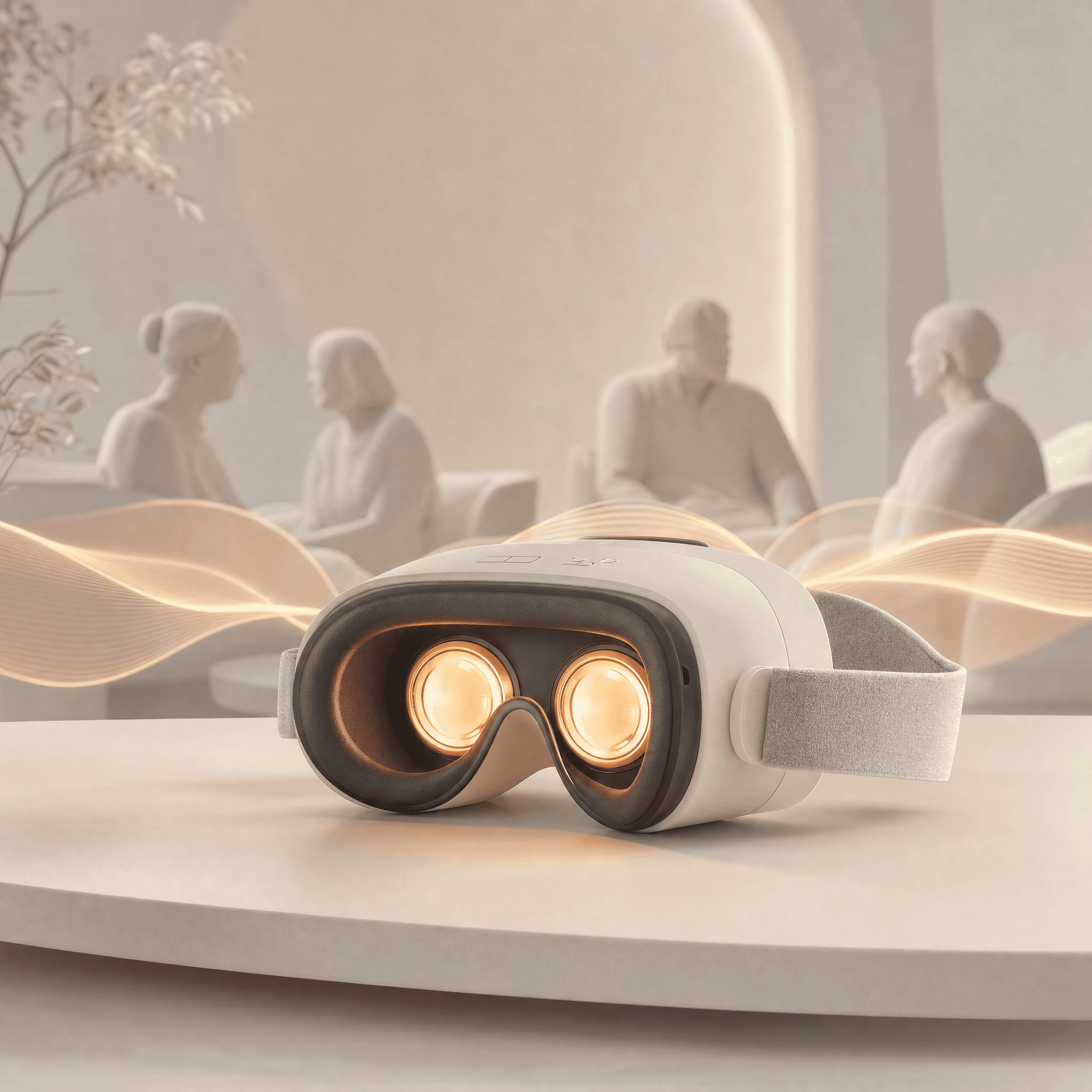
An 84-year-old woman in a nursing home in Trentino. She hasn't left the facility in two years. She has no close relatives. During a session with a VR headset, she is virtually transported to the shores of Lake Garda — the place where she grew up.
What happens next is documented by the caregivers: she smiles. She talks. She remembers details that hadn't surfaced in months. That afternoon, she eats better.
This is not an isolated case. It is a pattern replicated in dozens of studies.
The problem: isolation and cognitive decline in residential facilities
Nursing homes and care facilities house people who have lost — to varying degrees — autonomous access to the outside world. Isolation is not only emotional: it is cognitive, sensory, and relational.
The documented consequences of chronic isolation in institutionalized elderly patients:
Acceleration of cognitive decline — insufficient environmental stimulation reduces neuroplasticity
Depression and apathy — 30-40% prevalence in European nursing homes
Reduction in appetite and sleep quality
Increase in agitated behavior in patients with dementia — often a consequence of boredom and understimulation
Faster deterioration of quality of life compared to non-institutionalized elderly patients with equivalent pathologies
Traditional animation activities — bingo, craft workshops, music — have value but objective limitations. They do not reach patients with reduced mobility, are not always available, and do not produce the same intensity of sensory stimulation.
What VR does in this context
Virtual reality for the elderly in nursing homes is not pain therapy. It is stimulation. Remembrance. Presence.
The most effective VR environments in this context are:
Significant places for the person (hometown, the sea, the mountain where they used to ski) — they evoke autobiographical memory, one of the memory systems most resistant to dementia
Relaxing natural environments — they reduce agitation, lower heart rate, and improve mood
Simple interactive experiences — fishing games, virtual gardening — which stimulate residual motor skills and intentional responses
Immersive musical experiences — music combined with VR produces intense emotional responses even in patients with advanced dementia
Clinical evidence
Research on VR for the elderly and dementia has grown sharply over the last three years:
Casa di Cura Margherita Grazioli Study, Trento (2025): 40 elderly people with and without cognitive decline — significant improvement in subjective well-being, reduction in agitated behavior, increased active participation in subsequent sessions
JMIR XR (2024): feasibility study in a nursing home for people with dementia — VR produces positive cognitive, motor, and emotional responses. No adverse effects. High acceptability even in patients with moderate dementia.
MDPI Review (2025): proof-of-concept study on aesthetic and evocative content for elderly people with cognitive decline — activation of episodic and autobiographical memory with VR is superior to traditional reminiscence techniques
Alzheimer Research Foundation (2025): VR helps elderly people with dementia recall precious memories — documented effect on semantic and autobiographical memory
Practical protocol in nursing homes
Integrating VR into a residential facility is simpler than in a hospital ward:
Individual or small group sessions of 15-20 minutes
Recommended frequency: 2-3 times a week to maximize the effect on cognitive stimulation
Activity staff can manage the device independently after 30 minutes of training
For patients with dementia: presence of a caregiver throughout the session for monitoring and support
Personalized content for each resident: significant places, favorite music, activities related to their life history
Considerations for patients with dementia
Patients with moderate dementia can use VR with excellent results, but require some precautions:
Shorter sessions (10-15 minutes) to avoid cognitive fatigue
Simple and familiar environments, not complex or overstimulating experiences
Constant presence of the caregiver to manage any disorientation
Individual assessment: some patients with advanced dementia may not tolerate the headset — VR is not suitable for everyone
The value for the residential facility
In addition to the direct benefit to residents, VR produces operational advantages for the facility:
Reduction in agitated behavior — fewer corrective interventions by staff
Improvement in the quality perceived by the family — a critical indicator for the facility's reputation
Competitive differentiator in a market where technological innovation is still rare
Clinical assessment tool — the patient's responses during VR provide information on the level of cognitive deterioration that standardized tests do not always capture
Conclusion
Virtual reality does not cure dementia. It does not stop cognitive decline. But it can give an elderly person back an afternoon in which they feel alive — in which they remember, smile, and share stories. In a context where the quality of the remaining time matters more than the quantity, this is everything.