Jun 4, 2026
The Nurse Who No Longer Has to Say 'Stay Still'
The Nurse Who No Longer Has to Say 'Stay Still'
The scene every nurse knows
The patient walks in. You can see it in their eyes: they are terrified. Their hands are shaking. They sit on the blood-draw chair as if it were an electric chair.
You know that the blood draw will take 30 seconds. That the needle is thin. That the pain is minimal. But they don't know it — or rather, their body doesn't know it. Their nervous system has decided that this is a threat, and no rational words will convince them otherwise.
So you start the script: "Relax. Look the other way. Breathe. Stay still. We're almost there."
Does it work? Sometimes. Often not. And when it doesn't work, the patient moves, the vein rolls, you have to try again, and trust crumbles a little more.
The emotional weight of restraint
Nobody chose to become a nurse to hold down a screaming child. Nobody studied for three years to tell a panicking adult "stay still."
Yet it is part of the daily job. And it carries an emotional burden that is rarely recognized:
The frustration of not being able to calm a patient
The guilt of causing pain (even if necessary)
The stress of managing a procedure on a tense body
The weariness of repeating the same script dozens of times a day
Over time, this wears you down. This isn't burnout from grueling shifts — it's a more subtle erosion: the feeling that your job is "hurting people for their own good."
When the headset changes the frame
Imagine the same scene, but different.
The patient walks in. You can see it in their eyes: they are terrified. But this time you say: "Would you like to try the headset? It will make the time go by."
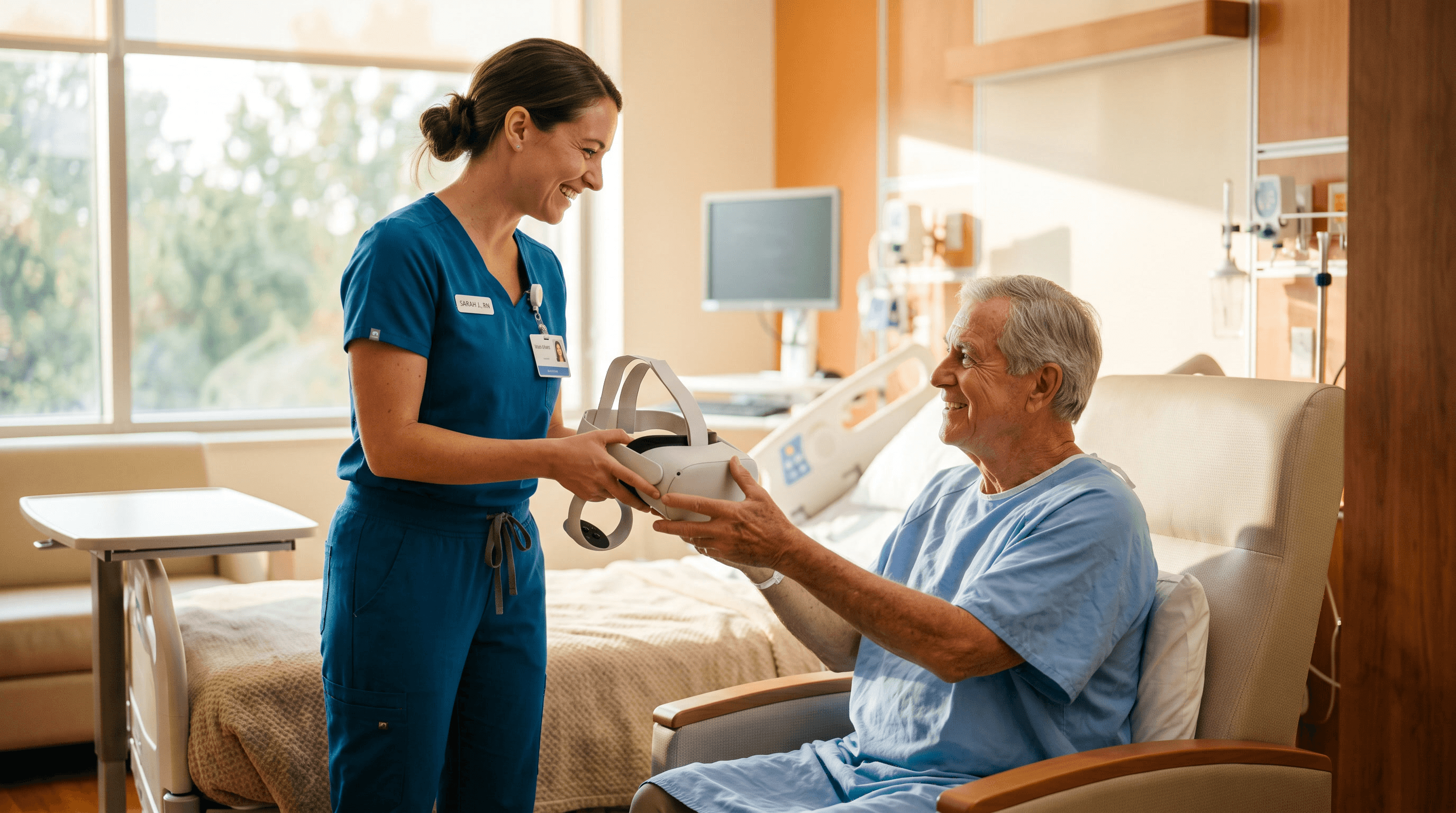
They accept. They put it on. In 10 seconds they are elsewhere — in a forest, on a beach, in a game. Their body relaxes. The vein becomes visible. The needle enters without resistance. When you remove the headset, they smile.
You didn't have to say "stay still." You didn't have to restrain. You didn't have to manage a crisis. You did your job — the blood draw — in a context of calm.
From restrainer to facilitator
This is the paradigm shift for healthcare staff: moving from the role of restrainer ("I hold the patient still so the procedure can happen") to that of facilitator ("I offer the patient a tool so the procedure is peaceful").
The difference is huge on an identity level. The facilitator helps. The restrainer forces. Even if the ultimate goal is the same (the procedure is performed), how you get there changes how you feel at the end of the shift.
Concrete benefits for workers
Fewer failed procedures
Relaxed patient = visible veins = successful first attempt. Fewer repetitions, less frustration, less wasted time.
Fewer emotional confrontations
You don't have to manage crying, screaming, refusals, fainting. The energy you spent "convincing" the patient can be used to care.
More time for connections
The 3-5 minutes you spent calming an anxious patient become 20 seconds of headset setup. The time saved is time you can dedicate to a kind word, a question, a smile.
Less cumulative stress
A day of peaceful blood draws is different from a day of fought-out ones. The emotional burden at the end of the shift is measurably lower.
Sense of efficacy
Offering a tool that works gives a sense of competence and care that a simple "stay still" cannot provide. You feel useful, not just technical.
Resistance to change
"It's a toy." "We don't need it." "I've always done it this way and patients survive."
These are understandable objections. Any novelty in an already stressed environment is seen as an added complexity. But VR doesn't add complexity — it removes it. It removes the complexity of managing a panicking patient.
And "patients survive" is not the standard. Surviving is not being well. And making patients feel comfortable is not an option — it is the reason why this job exists.
Training
Learning to use a therapeutic VR headset takes less than 30 minutes. You don't need to be technical. You don't need to understand how the technology works. You only need to know: turn on, place, choose the experience, do the procedure.
If you know how to use a pulse oximeter, you know how to use a VR headset. This principle — simplicity as a fundamental requirement — is what distinguishes a tool that is used every day from one that ends up in a drawer.
A new type of care
The next time a terrified patient sits in front of you, imagine having a tool that transforms those 30 seconds of battle into 30 seconds of calm.
Not just for the patient. For you too. The same tool works with terrified children and with adults with needle phobia.
The nurse's job is to care, not to restrain. Immersive therapy returns to healthcare staff the role they chose this profession for. With Lemons in the Room, already in over 30 healthcare facilities, nursing staff start a session in less than 10 seconds — without technical training, without complications. Find out how it works in blood-draw centers.