May 28, 2026
Humanization of care: When technology puts the patient back at the center
Humanization of care: When technology puts the patient back at the center
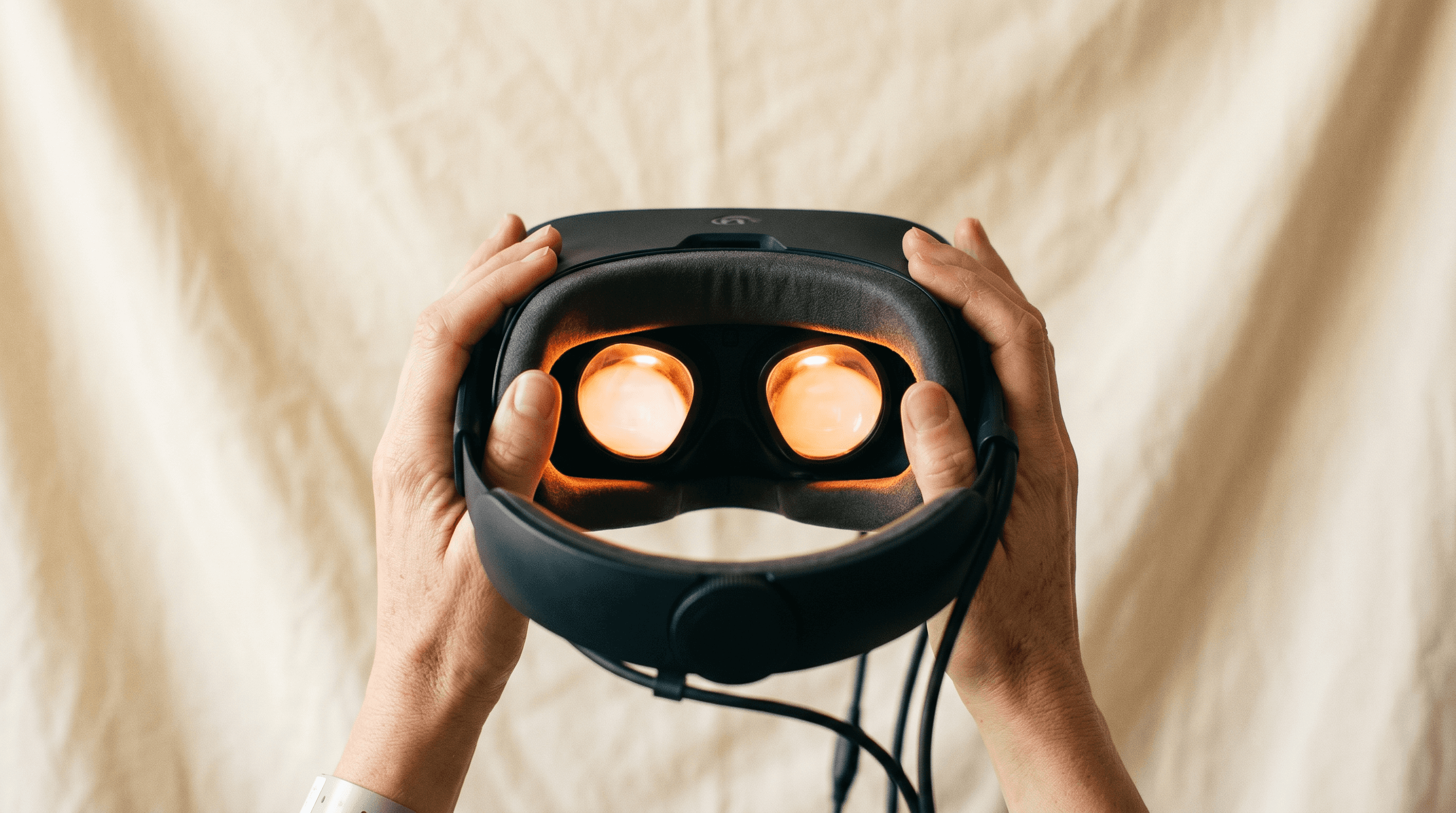
The paradox
Putting a VR headset on a patient's face to make them more "human" seems like a contradiction. Technology in hospitals evokes lab coats, screens, numbers, protocols. It does not evoke warmth.
Yet, let's try to flip the perspective.
What is more human: a patient paralyzed by terror who is physically restrained by four healthcare workers for a blood draw — or the same patient smiling inside a headset while a nurse inserts the needle without them even noticing?
Humanization is not the absence of technology. It is the presence of attention.
What "humanizing" really means
In the Italian healthcare debate, "humanization of care" has become almost a slogan. Everyone quotes it, few define it. Even fewer measure it.
At its core, humanizing means something simple: putting the patient's experience at the center of the design of the care pathway. Not as a secondary goal. Not as a "plus" to be added if there is budget leftover. But as a primary design criterion.
This requires answering uncomfortable questions:
Does the patient suffer more than necessary during this procedure?
Could we reduce their suffering with the resources we have?
Are we doing everything reasonably possible for their comfort?
Where traditional medicine stops
The traditional model is: solve the clinical problem. If the patient suffers during the procedure, it is the price to pay for the result.
This model worked when there were no alternatives. But today, alternatives exist. And not using them is a choice — not a constraint.
Technology as an enabler of empathy
Healthcare staff are empathetic. That is not the problem. The problem is that empathy alone is not enough when a patient is in a panic.
A nurse can be extremely kind, competent, communicative. But if the patient is stiff with terror, there is no relational technique that will transform that blood draw into a neutral experience. We explain this from the perspective of the staff in The Nurse Who No Longer Has to Say 'Stay Still'.
VR does not replace the healthcare worker's empathy. It enables it. It gives the healthcare worker a concrete tool to translate their intention to care into an effective action. "I wish you didn't have to suffer" becomes "here is something that will help you not suffer."
The freed-up time
There is an underestimated side effect of immersive therapy: it frees up relational time.
Without VR, the nurse spends minutes calming an anxious patient. They reassure them, explain, wait for them to relax, try again if the first attempt fails. That time is spent managing a crisis.
With VR, the crisis does not manifest. And the time the nurse would have spent containing the anxiety becomes time available for the relationship: a smile, a word, a "how are you doing today?". Paradoxically, technology frees up space for human interaction.
Measuring humanization
"Not everything that counts can be counted" — that's true. But much of what counts in the patient experience can be measured (and as Pain Is Not a Price to Pay explains, today there is no longer any excuse not to do so):
Perceived pain (VAS scale): measurable
Pre-procedural anxiety (STAI scale): measurable
Patient satisfaction (NPS): measurable
Adherence to follow-up: measurable
No-show rate: measurable
Immersive therapy improves all of these indicators. It is not an opinion — it is a fact.
The signal you send
When a patient enters a ward and sees that VR is available for their comfort, they receive an implicit message: "we care about how you feel, not just about what we diagnose you with".
That message is worth more than any communication campaign. It is humanization made visible, tangible, experiential.
For a private clinic, it is also positioning: you are the place where the patient is a person, not a number. For a public hospital, it is a signal of attention to perceived quality, not just clinical quality.
Not everything new is good. But not everything traditional is better.
Resistance to technology in healthcare is often masked as prudence. "We don't need it", "we've always done it this way", "patients won't ask for it".
But patients don't ask for things they don't know exist. They wouldn't have asked for smartphones in 2005. They wouldn't have asked for anesthesia in 1840.
The role of healthcare designers is to anticipate the need, not wait for the demand.
Humanizing care is not a luxury. It is a duty. And today we have the tools to do it in a measurable, scalable, and sustainable way. Lemons in the room was born with this mission: to make every medical procedure more human, in over 30 Italian healthcare facilities, without complicating the work of staff.
See also: The Ward Patients Choose to Talk About | What the Patient Will Remember in 10 Years