Jun 19, 2026
How to relax an anxious patient: A practical guide for clinics
How to relax an anxious patient: A practical guide for clinics
The problem that every clinic knows
The patient is sitting down. They booked the treatment weeks ago. But now that they are here, they are tense. They talk fast. They ask repetitive questions. They clench their hands. Or conversely: they are silent, rigid, with a blank stare.
No matter how experienced your team is. An anxious patient complicates everything: the procedure is more difficult (contracted muscles), the results can be compromised (the patient moves), and the perception of pain is amplified.
Why patients are anxious
Pre-treatment anxiety in aesthetic clinics has specific sources:
Fear of pain: "How much will it hurt?" is the number one question
Fear of the result: "What if it turns out bad? What if I don't like it?"
Vulnerability: being semi-undressed, with a stranger operating on one's body
Previous negative experience: a painful session in another center
Fear of needles: for any injectable treatment (filler, mesotherapy, carboxytherapy)
What does NOT work
"Relax"
Telling someone to relax has never relaxed anyone. It's like saying "don't think about the elephant". The implicit command increases the awareness of anxiety.
Minimizing
"It doesn't hurt" or "it's nothing" invalidates the patient's experience. If it is something to them, it is.
Ignoring
Proceeding as if the anxiety weren't there. The patient feels unseen and tension rises.
What WORKS: the 5 strategies
1. Anticipatory communication
Explain exactly what will happen, step by step, before doing it. "Now you will feel a bit of cold. Then a slight pinch. It will last about 3 seconds."
Predictability reduces anxiety. The unknown amplifies it.
2. Give control
Offer a "stop" word. "If at any point you want me to stop, just say stop and I will stop immediately." The simple fact of having the power to interrupt reduces the need to do so.
3. Sensory environment
Soft music, comfortable temperature, non-aggressive lighting, pleasant scent. Each sense that receives a "safety" signal helps to lower the activation of the sympathetic nervous system.
4. Conversational technique
Talk about neutral or pleasant topics during the procedure. Ask open-ended questions ("where will you go on vacation?"). The brain cannot process a conversation AND monitor anxiety at the same time.
Limitation: it works for short procedures. For 30-60 minute sessions, the conversation runs out. This is where technology comes in — to understand the science behind it, read why VR reduces pain neurologically.
5. Technological immersive distraction (VR)
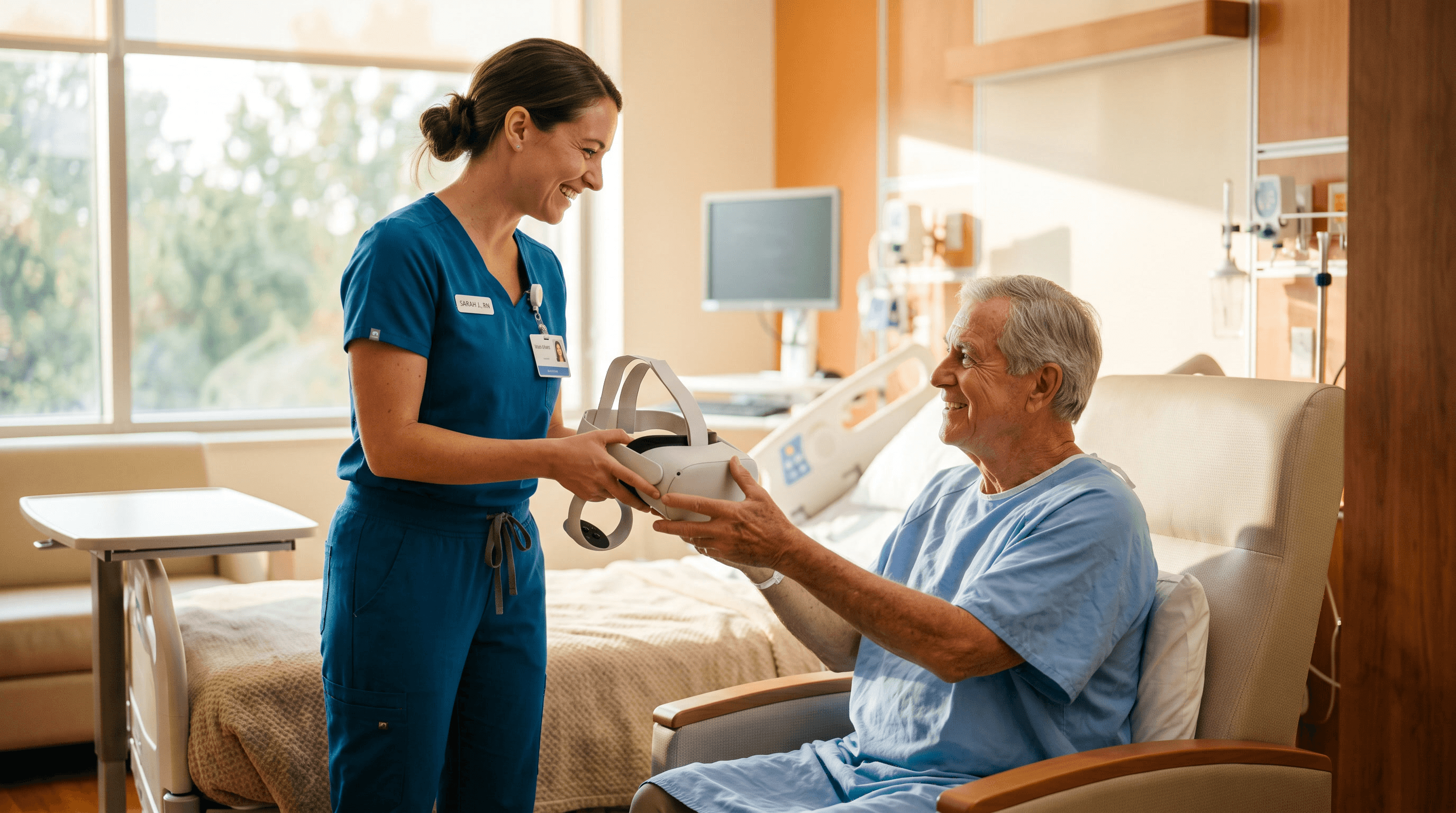
The most effective solution for long sessions or highly anxious patients: a virtual reality headset that transports the patient into another environment.
Why it is superior to conversation:
It doesn't run out (60+ minutes of content)
It does not depend on the communication operator's skills
It is 100% immersive (sight + hearing isolated from the clinic environment)
It also works with introverted patients who do not want to chat
Reduces perceived pain by 44% (clinical data, not opinion)
The business impact
A relaxed patient:
Has a better perception of the treatment (positive reviews)
Comes back for subsequent treatments (retention)
Speaks highly of it (word of mouth)
More easily accepts additional treatments (natural upsell)
Does not ask for refunds due to a "negative experience"
An anxious patient:
Perceives more pain (even with the same procedure)
May not complete the treatment cycle
Leaves negative reviews focused on pain
Does not return and does not recommend
Investing in patient comfort is not a cost. It is retention.
Competitive differentiation
In the aesthetic medicine market, everyone offers the same treatments with the same technologies. The difference is made on the experience.
The clinic that makes the patient feel "cared for" even during the uncomfortable moment is the one the patient chooses to talk about. And in a market where word of mouth is the prime acquisition channel, this is worth more than any advertising investment.
Managing patient anxiety is not just kindness. It's strategy. Lemons in the room is the immersive distraction system already chosen by aesthetic clinics and 30+ healthcare facilities: MDR certified, it activates in 10 seconds, reduces perceived pain by 44%. The technology does the heavy lifting, your team does the relationship.
Read also: Patient Experience in Aesthetic Clinic: The Lever That Differentiates You | Does Laser Hair Removal Hurt?