Jun 5, 2026
Fear of blood draws in adults: Causes and practical solutions
Fear of blood draws in adults: Causes and practical solutions
You are not the only one
If the mere thought of a blood draw makes your hands sweat, if you have been postponing tests for months (or years), if you feel ashamed because "you are an adult and shouldn't be afraid" — know that you are not alone.
Approximately 10% of the adult population suffers from trypanophobia (clinically significant fear of needles). Another 20-30% experience high levels of anxiety, even without a formal diagnosis.
These are huge numbers. Millions of people who every day avoid something that could save their life.
Why it happens
The fear of blood draws is not irrational. It has precise roots:
Traumatic childhood experience
The most common cause. A painful blood draw at age 5, an abrupt nurse, the memory of being held down. The brain registered: needle = danger. And that circuit is still active.
Vasovagal response
Some people have an involuntary physiological response to the sight of blood or the needle prick: drop in blood pressure, bradycardia, fainting. It is not psychological — it is a response of the autonomic nervous system.
Fear of losing control
The needle penetrates the body without you being able to do anything about it. For those who need to feel "in control", this passivity is intolerable.
Association with illness
For some, blood draws are not scary because of the pain but because of what they might reveal. The needle becomes the symbol of the dreaded diagnosis.
Social amplification
If as a child you saw a parent frightened by needles, your brain learned by imitation. Fear is transmitted.
The consequences (that no one calculates)
The fear of blood draws is not just an aesthetic inconvenience. It has real health consequences:
Blood tests postponed for years
Undiagnosed nutritional deficiencies (iron, vitamin D, B12)
Unmonitored tumor markers
Diabetes undiscovered until complications arise
Missed vaccines (including important boosters)
Pregnancies with insufficient check-ups
Refused intravenous therapies
It is no exaggeration to say that the fear of needles kills. Indirectly, through missed prevention.
5 solutions that work
1. Applied tension technique (for those who faint)
If your problem is fainting (vasovagal response), this technique is specific: tense the muscles in your legs, arms, and abdomen for 10-15 seconds before and during the blood draw. This maintains blood pressure and prevents fainting.
2. Supine position
Having the blood draw done while lying down eliminates the risk of falling and reduces the vasovagal response. It is not for the "weak" — it is clinically indicated for those who tend to faint.
3. Gradual exposure
Cognitive-behavioral therapy for phobias works: progressive exposure to the feared stimulus. It starts with looking at photos of syringes, then visiting a collection center without doing anything, then watching someone else get a blood draw, then doing your own. Effective, but it takes weeks/months and a therapist.
4. Communication with the staff
Saying it. It seems obvious, but many adults are ashamed. Telling the nurse "I'm afraid of needles" changes everything: they will use a thinner needle, talk to you, tell you exactly what to expect, and give you time.
5. Immersive distraction (VR)
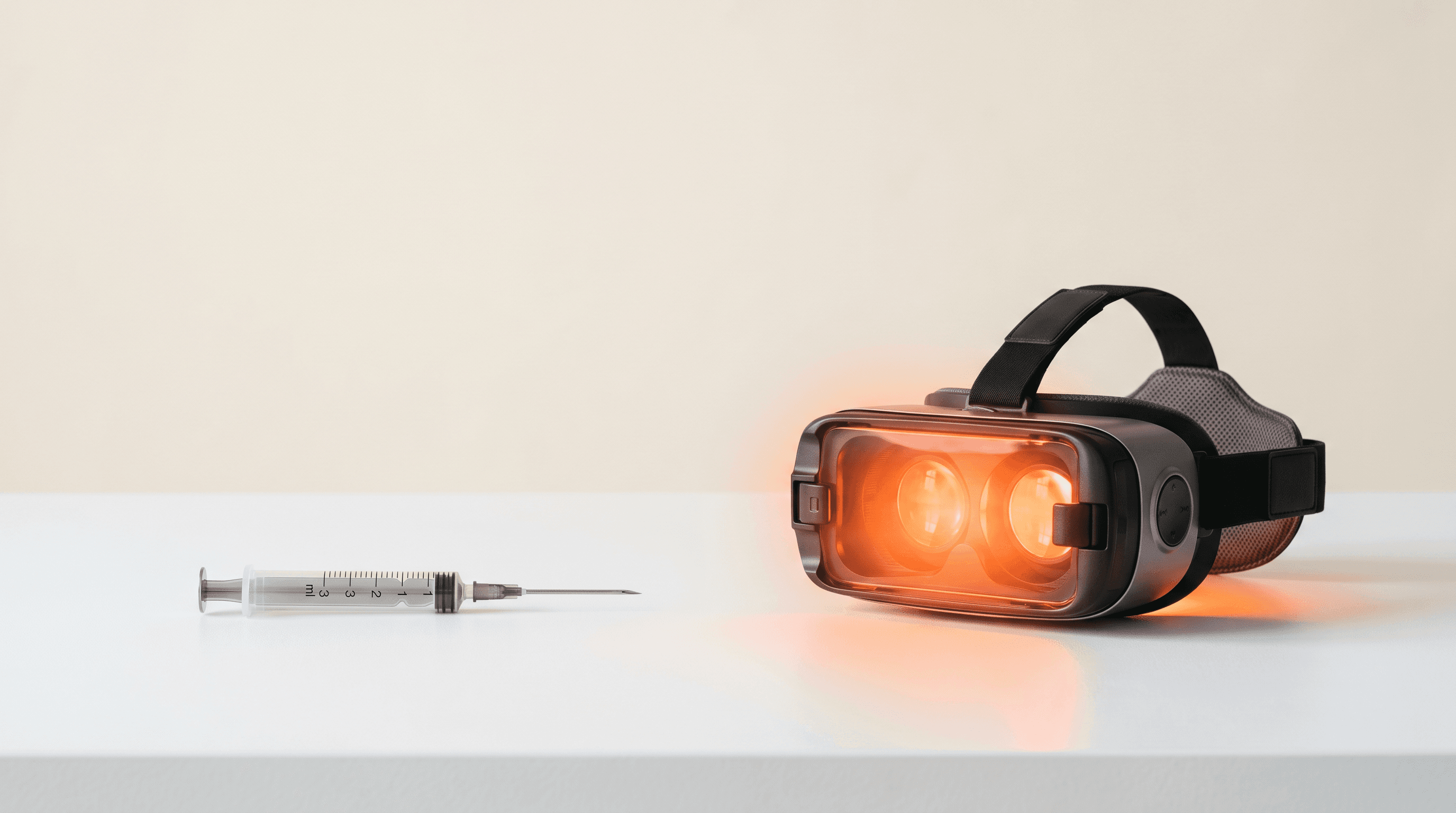
The latest and probably most effective solution in the context of the collection center: a virtual reality headset that immerses you in another environment during the procedure.
You don't see the needle. You don't see the preparation. You don't see the blood. Your brain is occupied elsewhere. And when the headset is removed, it is already over.
Clinical studies show a 44% reduction in anxiety and pain with immersive VR. For those with needle phobia, it is often the difference between "I'm not going" and "I did it." Learn more about the problem from a clinical clinical perspective: Needle Phobia in Adults: A Serious Problem.
The virtuous cycle
Each successful blood draw — every experience where nothing terrible happened — weakens the phobia. The brain updates its map: needle ≠ danger.
VR is not just a palliative for a single procedure. It is a desensitization accelerator. Every time you get a blood draw without panic thanks to VR, next time will be a little easier. Even without a headset.
How to find a center offering VR
Not all blood collection centers offer immersive therapy yet. But the number is growing rapidly. If you have a needle phobia:
Ask your local center if they offer distraction solutions for anxious patients
Look for centers that declare a focus on the patient experience
Inform your primary care physician that this option exists and that you would need it
Fear of blood draws is nothing to be ashamed of. It is a real problem with real solutions. Over 30 facilities in Italy already adopt Lemons in the room to offer patients with trypanophobia a concrete alternative: a VR headset that transforms a nightmare blood draw into a non-event. Find out how it works in blood collection centers.